









The News
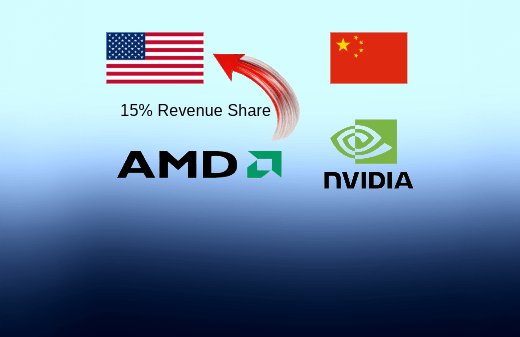
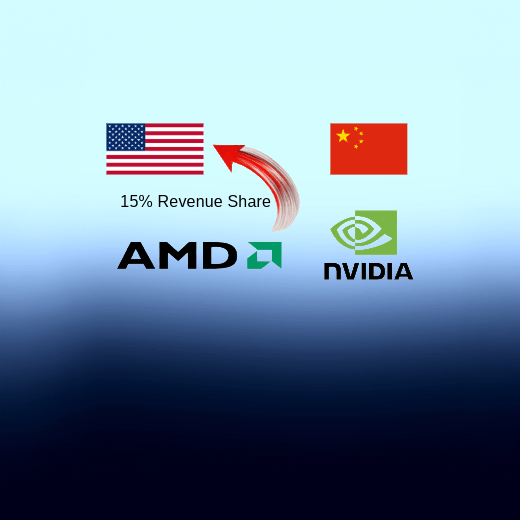
In a groundbreaking move, Nvidia and Advanced Micro Devices (AMD) have agreed to pay the U.S. government 15% of revenue from certain AI chips sold to China. In exchange, Washington will grant export licenses for Nvidia’s H20 and AMD’s MI308 processors — high-performance AI accelerators that had been restricted under U.S. export control rules.
The deal:
- Nvidia: ~$17 billion in annual China revenue → ~$2.55 billion potential U.S. share.
- AMD: ~$6.2 billion in annual China revenue → ~$930 million potential U.S. share.
- Combined: ~$3.48 billion/year to the U.S. Treasury.
The Supply Chain Reality
Despite the political framing, neither Nvidia nor AMD manufactures these chips in the U.S. or China.
Flow of Production:
- Design: U.S. (Santa Clara, CA HQ + global R&D) using U.S.-origin EDA tools. Nvidia and AMD are both fabless companies—they specialize in chip design (headquartered in the U.S.) and rely on U.S.-developed EDA software, which falls under U.S. export control regulations.
- Fabrication: Primarily TSMC in Taiwan, occasionally Samsung in South Korea. Nvidia outsources GPU and AI chip manufacturing to TSMC (Taiwan) and sometimes to Samsung Electronics (South Korea) for specific nodes.
- Packaging & Testing: Done in Taiwan, Malaysia, and sometimes mainland China for older products. Most advanced packaging is handled by OSAT (Outsourced Semiconductor Assembly and Test) firms located predominantly across Asia, especially Taiwan and China, with significant operations in Malaysia and other countries like Japan and Singapore.
- Distribution: Chips shipped to global customers, including China’s AI/cloud giants. Nvidia recently placed major orders for its H20 AI chips with TSMC, reflecting strong demand from Chinese AI/cloud players.
Key Control Point:
Even though fabrication is offshore, U.S. export control law governs these chips because they are based on U.S. intellectual property and designed using U.S. software. This gives Washington a powerful legal lever over sales to China.
The Strategic Logic Behind the Deal
This arrangement is more than just a revenue grab — it’s a multi-layered strategic play:
1. Control Without a Ban
- Washington avoids a full ban that could accelerate China’s push toward self-sufficiency in AI chips.
- By allowing sales but taxing them, the U.S. retains visibility into chip flows while extracting value.
2. A Geopolitical “Revenue Tariff”
- Unlike tariffs at the border, this is a direct revenue share tied to the sales themselves.
- Ensures the U.S. benefits financially from the very market it restricts.
3. Market Access as a Negotiation Tool
- The export license becomes a bargaining chip: if political tensions spike, licenses can be revoked instantly.
4. Strategic Dependency
- By keeping Chinese firms dependent on U.S.-designed chips (even if pricier), Washington maintains leverage over their AI development pace.
5. Signalling Power to Allies and Competitors
- Demonstrates to other tech sectors (quantum computing, biotech) that the U.S. can monetize strategic exports without total bans.
- Sets a precedent that other countries may copy.
The Economics of the 15% Model
For the U.S. Government:
- A predictable annual revenue stream without needing to fund R&D or production.
- Funds could be redirected into domestic semiconductor incentives (e.g., CHIPS Act programs).
For Nvidia & AMD:
- Short-term win: Market access to China is preserved, protecting billions in revenue.
- Long-term risk: Sets a precedent that governments can demand a cut of revenue in exchange for market access — potentially in Europe, India, or other large markets.
For China:
- Access to cutting-edge AI chips remains intact, albeit at higher cost.
- Could accelerate local AI chip development (Huawei Ascend, Biren) to escape dependency.
Supply Chain & Market Reactions
Winners
- TSMC & Samsung: Continued orders for advanced nodes from Nvidia/AMD.
- U.S. Treasury: Multi-billion annual inflow from tech exports.
- Chinese AI Leaders (short-term): Can still run large AI models with top-tier hardware.
Losers
- Chinese Startups (long-term): Higher chip prices make AI training more expensive.
- Global AI Pricing: Rising costs could cascade into higher prices for AI services worldwide.
- Competitors: May face new barriers if similar revenue-sharing rules spread.
Global Implications
- Policy Monetization
Other countries may begin charging “market access fees” for strategic tech. - Pricing Fragmentation
The same chip could have different global price tags depending on political alignment. - Accelerated Decoupling
China may double down on indigenous chip ecosystems, from design to fabrication. - New Trade Templates
This could become the model for biotech, quantum, or green tech exports — not just semiconductors.
Strategic Takeaway
The 15% chip toll is not just a compromise.
It’s a new economic model — monetizing geopolitical leverage while controlling technology flows.
Washington has positioned itself as a passive shareholder in U.S. chip sales to China without building a fab, designing a chip, or shipping a single wafer.
If the model works, we may see similar deals in every industry where technology is both high-value and geopolitically sensitive.