






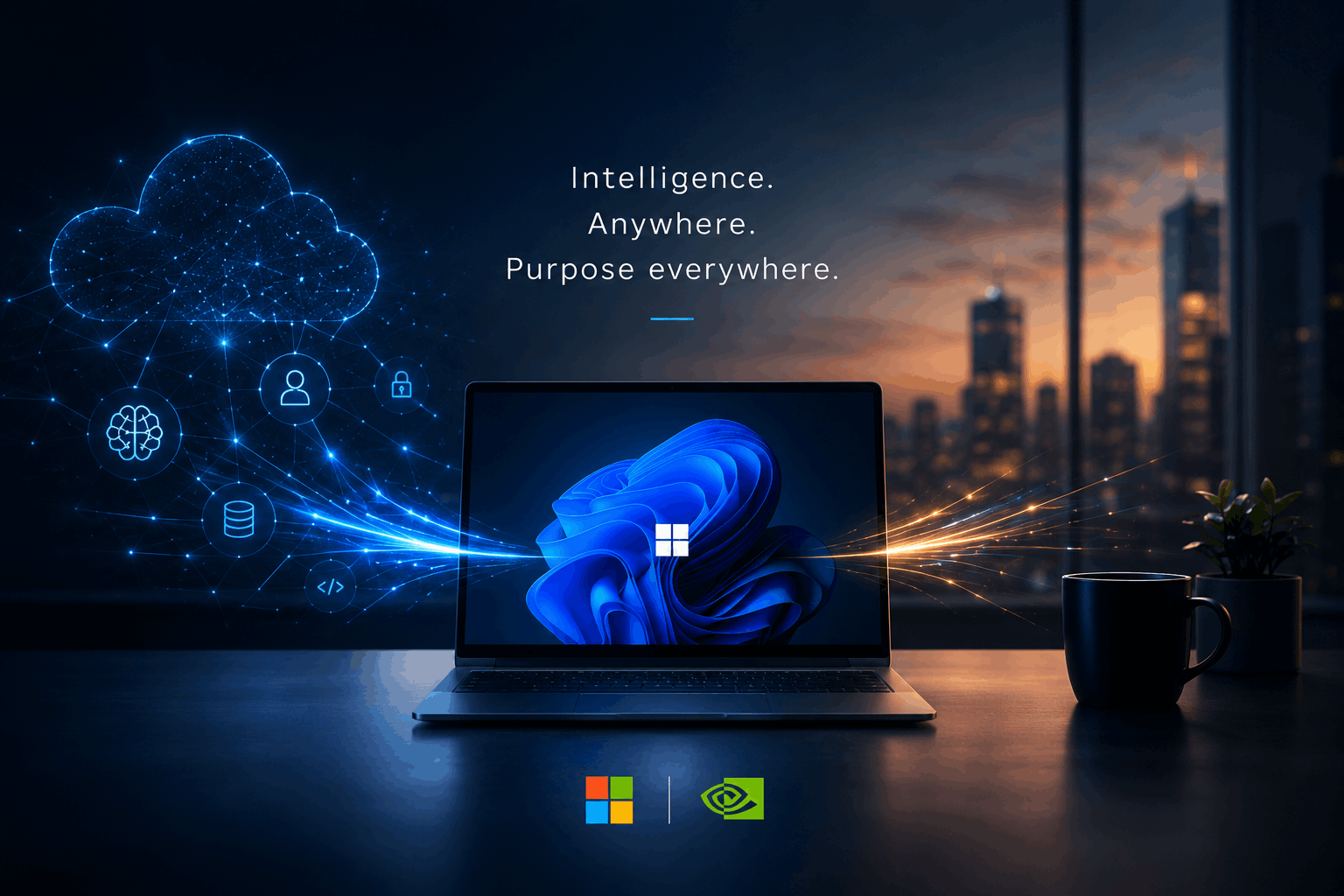
When Satya Nadella and Microsoft announced a new chapter for Windows PCs powered by NVIDIA RTX Spark, many people focused on the hardware specifications.
The headlines talked about AI PCs.
The technology press focused on performance figures.
Industry analysts discussed NVIDIA’s growing influence over the future of computing.
However, beneath the specifications sits a much larger story.
The announcement may represent the beginning of a shift from cloud-centric intelligence towards a more distributed model where intelligence operates across devices, cloud platforms, enterprise systems, and human decision-makers.
What Was Actually Announced?
Microsoft and NVIDIA introduced a new class of Windows PCs powered by NVIDIA RTX Spark, described as the world’s most powerful and efficient thin-and-light Windows PCs. These systems are designed specifically for developers, creators, power users, and what Microsoft describes as the next wave of AI agents.
The technology is significant because it combines:
- NVIDIA Blackwell RTX GPU technology
- Arm-based CPU architecture
- Unified memory architecture
- Local AI execution capabilities
- Native Windows integration
- Agent-oriented computing experiences
into a single platform.
Unlike traditional PCs that primarily act as clients connecting to cloud services, RTX Spark systems are designed to execute advanced AI workloads directly on the device itself.
The Technology Behind RTX Spark
The flagship RTX Spark platform includes:
- 20-core CPU architecture
- NVIDIA Blackwell GPU architecture
- 6,144 CUDA cores
- Fifth-generation Tensor Cores
- Up to 128GB unified memory
- Approximately 1 petaflop of AI performance
all packaged into thin-and-light Windows devices.
To put that into perspective, capabilities that previously required workstation-class systems or cloud resources are increasingly becoming available on portable devices.
NVIDIA states that these systems can support large AI models locally and are designed for AI-assisted development, content creation, advanced graphics workloads, and agentic computing scenarios.
Why NVIDIA Is Calling This the AI PC Era
Jensen Huang described this as a reinvention of the personal computer for the AI era. Industry observers have similarly characterised the announcement as a move from application-centric computing towards agent-centric computing.
Historically, users interacted with applications.
Open Word.
Open Excel.
Open Outlook.
Open ERP.
Open a browser.
The emerging vision is different.
Users increasingly interact with AI agents capable of navigating systems, retrieving information, analysing data, generating content, and assisting with decision-making.
In this model, the operating system becomes more than a launcher of applications.
It becomes an environment for intelligent agents.
The Most Interesting Architectural Question
For enterprise architects, the announcement raises a more strategic question.
Where should intelligence execute?
For the last several years, AI has largely followed a cloud-first model.
A user request travels to a hyperscale data centre.
The model executes remotely.
Results are returned to the user.
RTX Spark introduces a different possibility.
Many workloads may execute directly on the device.
Others may continue to rely on cloud-scale resources.
The future is unlikely to be cloud-only.
It is equally unlikely to be device-only.
The future may be distributed.
A New Layered Model of Enterprise Intelligence
A useful way to think about the future is through four complementary layers.
Hardware Provides Capability
Modern AI hardware provides the computational foundation required for local inference, advanced graphics, and agent execution.
AI Provides Intelligence
Models provide reasoning, generation, prediction, and analysis.
Data Provides Context
Enterprise knowledge, business processes, ERP data, operational information, and organisational memory provide context.
Humans Provide Judgement
Human oversight remains responsible for accountability, governance, prioritisation, ethics, and decision-making.
As AI systems become more capable, this final layer becomes increasingly important.
What Could This Mean for ERP and Enterprise Platforms?
This is where the announcement becomes particularly relevant.
Imagine a future Dynamics 365, SAP, Oracle, or Salesforce environment where:
- Local AI analyses spreadsheets without cloud latency
- Finance teams receive intelligent recommendations directly on the device
- Procurement teams analyse contracts locally
- Supply chain managers receive instant operational insights
- AI assistants operate across enterprise applications
while cloud platforms continue to provide:
- Enterprise knowledge
- Governance
- Security
- Identity
- Data integration
- Large-scale orchestration
This creates a distributed intelligence model rather than a centralised intelligence model.
A Leadership Perspective
Many leadership traditions teach a common lesson.
Capability alone rarely determines outcomes.
Context, guidance, and judgement matter equally.
The Mahabharata illustrates this through the relationship between Arjuna and Krishna.
Arjuna possessed the capability to act.
Krishna provided context, guidance, and perspective.
Neither alone was sufficient.
The AI era may require a similar balance.
Hardware provides capability.
AI provides intelligence.
Data provides context.
Humans provide judgement.
Cloud platforms provide coordination and scale.
Looking Ahead
Microsoft’s RTX Spark announcement is undoubtedly a hardware story.
It is also an architecture story.
For the past decade, enterprise technology has largely focused on moving workloads into the cloud.
The next decade may focus on determining where intelligence should execute.
The most important debate may not be cloud versus edge.
It may be how humans, AI, devices, and cloud platforms work together as a trusted operating model.
That is the conversation enterprise leaders should be paying attention to today.